While working on Ged the Goatherd, I looked at real world societies to help give form to the people of Gont in Ursula Le Guin's fantasy world of Earthsea
Did some reading on Kazakh people in Central Asia and the Dine (Navajo) people in North America and found interesting similarities in the history of these two very different regions:

Tuesday, October 28, 2014

Saturday, September 27, 2014
Ged the Goatherd

Fanart for Ursula Le Guin's "A Wizard of Earthsea". The protagonist Sparrowhawk (aka Ged) spent his childhood on the island of Gont.
Real world cultural inspirations I used for envisioning Gontish clothing styles: Navajo, Tibetan, Uzbek, Kazakh.
Reasons for looking to these particular cultures:
- Presence of a sheep herding/goat herding economy, which is practiced on Gont.
- Use of clothing elements mentioned in the Earthsea Cycle's description of Gontish people, such as jerkins, aprons and ruffles. (Not necessarily common or native to each of the societies mentioned, but between all of them, there is the use of such items, or something pretty close, in traditional clothing.)
Friday, August 29, 2014
Crossing the water on the backs of beasts
Filipino, Malaysian and Japanese tales about a small clever animal who tricks dangerous creatures into serving as its "bridge" :
Notes:
| Region | Small Trickster vs Big Predators | Tale |
|---|---|---|
| Malaysia | Mouse-deer tricks Crocodiles | Sang Kancil, startled by a crocodile on a river bank, talks his way out of danger by claiming to be taking a crocodile census on the order of the king. When the crocodiles line up on the surface of the water, Sang Kancil crosses to the other bank by hopping from one crocodile's back to another's.1,2
The animal kancil, pronounced 'kanchil', is also known as the lesser mouse-deer or lesser Malay chevrotain.3 |
| Philippines | Mouse-deer tricks Crocodiles | Pilandok wanted to cross a deep river, so he calls out to the crocodiles, pretending that he needed to count them. After stepping across their backs to the other side, Pilandok mocks them and flees.4,5
The animal called pilandok is also known as the Philippine mouse-deer or the Balabac chevrotain.6 |
| Japan | Hare tricks Wanizame | A hare wanted to cross from an island of Oki to Cape Keta, so it lied to a clan of wanizame about counting them to see whose clan was bigger.7 (Wanizame are variously interpreted as sharks, soft-shell turtles, or crocodiles.8) Although the hare managed to cross the sea by stepping on the backs of these creatures, the trickster of this tale fared much worse than its counterparts in Southeast Asia.9 |
Notes:
Sunday, July 27, 2014
Voyage
Inspired by the East Timorese myth of "The Boy and the Crocodile".
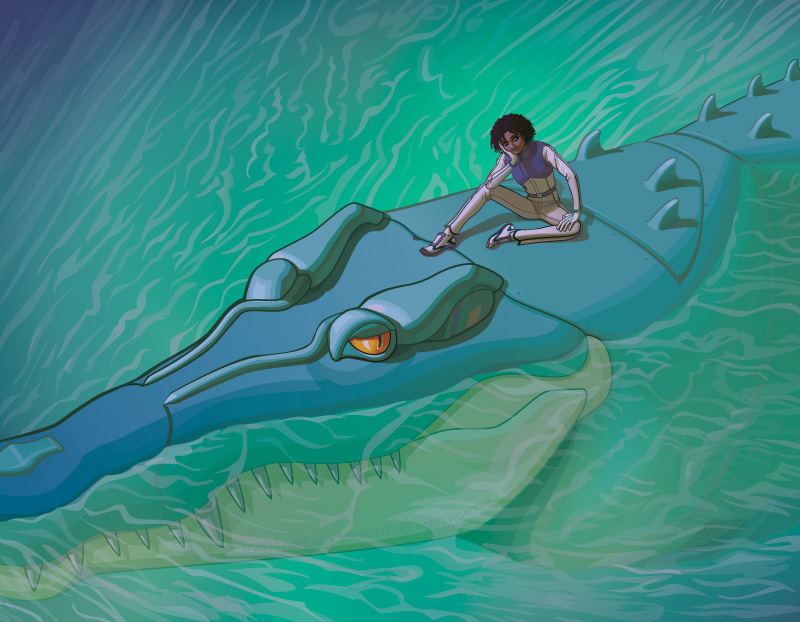
Here are 3 different versions of the story:
Here are 3 different versions of the story:
- Legend of East Timor: The Crocodile Story (East Timor and Indonesia Action Network)
- The crocodile that became Timor (from Fernando Sylvan's "Cantolenda Maubere")
- Some cultural notes, humors and myths from Timor-Leste (Diak Ka Lae? A Dummy's Guide to Timor-Leste)
Print available!
This is the third and final piece in the giant robots series. Many thanks to the kind friends who assisted with critique.
This is the third and final piece in the giant robots series. Many thanks to the kind friends who assisted with critique.
Thursday, June 26, 2014
Henna Art from Around the World
Been listening to Rango, and their rendition of Henna Night is stuck in my head. :-) Hence the inspiration for this post:
 |
| henna-decorated foot in Morocco |
 |
| henna-painted hands in India |
Click thumbnails to view larger images on source pages.
Some African and Asian cultures that decorate brides (and, in some cases, grooms) with henna:
Wednesday, May 28, 2014
Cheetah Weeping

When the mother's grief came to the attention of an old man from the hunter's village, he informed the village elders of the hunter’s conduct. The villagers expelled the hunter. The old man returned the cheetah cubs to their mother, reuniting the family. But the tear tracks remained on the cheetah’s face as a reminder to hunters not to do wrong again.
The moral condemnation for keeping hunting cheetahs is certainly not universal. Listed here are a few (not all) of the peoples that had tamed cheetahs for hunting:
Sunday, April 27, 2014
Sand painting in Asia and North America
Click thumbnails to view larger images on source pages.
Some cultures that practice impermanent sand painting:
 |
| Navajo sand painting |
 |
| Indian kolam |
Some cultures that practice impermanent sand painting:
Subscribe to:
Posts (Atom)