Parallels in homoromantic stories recorded in 11th century Muslim Spain and 18th century China.
Sunday, February 8, 2026
Tuesday, July 8, 2025
Persian and Urdu homoromantic poetry from 13th-19th century South Asia
The intense spiritual bonds between Sufi masters in South Asia and their same-sex disciples have been expressed in homoromantic and homoerotic poetry.
While it may not be appropriate to label these relationships using modern Western concepts of sexual orientation and romantic orientation, they can provide perspectives on the intersection between divine love and same-sex human love. The experience of holiness is not tied to heteronormativity.
Thursday, May 8, 2025
Men who love men in the orbit of the 18th c. queer writer Yuan Mei
Numerous gay/bi/pan men, both obscure and famous, passed through the artistic circles of Yuan Mei. Learn more about the pansexual, polyamorous Yuan Mei and his non-heterosexual friends on our Patreon.
Sunday, September 8, 2024
Pansexual and bisexual emperors of the Han Dynasty, according to 1st c. BCE court historian Sima Qian
Btw, Bisexuality Awareness Week starts on Sep 16.
Wednesday, May 8, 2024
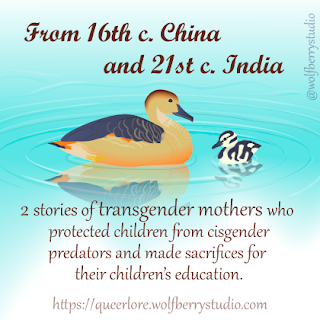
From 16th c. China and 21st c. India, two accounts of virtuous transgender mothers who protected children
The ducks in the picture are Lesser Whistling Ducks, a species present in the India subcontinent, southern China and Southeast Asia. Female and male ducks are similar in plumage.
Read more LGBTQ history on our Substack
Happy Mother's Day to the trans moms!
Friday, March 8, 2024
Zhang Yujing, trans masculine folk hero, honored by the Emperor of China in 1405
Read more about their life at Zhang Yujing, trans masculine folk hero, honored by the Yongle Emperor in 1405
Thursday, February 8, 2024
Friday, December 8, 2023
Zheng Banqiao, openly bisexual 18th century magistrate, honored with a shrine for disaster relief work
Read more about the storied life of this eccentric, multi-talented character here. Zheng's legacy remains influential to this day; he inspired no less than 3 (straight-washed) TV series and feature films.
Friday, June 26, 2015
Fantasy and mythology art inspired by the Middle East
Friday, January 24, 2014
Lattices (and other parallels between Qing-era China and Mughal-era India)
For beardless versions of these gentlemen, see Portrait of an Official and Portrait of a courtier. :-)
Some random (or not so random) parallels between the Qing period (1644-1912) in China and the Mughal period in India (1526-1857):- Both dynasties were established by non-indigenous rulers:
- The Mughal Dynasty was established on the Indian subcontinent by Turko-Mongols from Uzbekistan.1
- The Qing Dynasty was established in China by Jurchens from Manchuria (present-day Northeastern China).2
- The capitals of both the Qing and the Mughals experienced repeated slaughter of their populations, looting of cultural treasures and destruction of exquisite architecture:
Friday, December 27, 2013
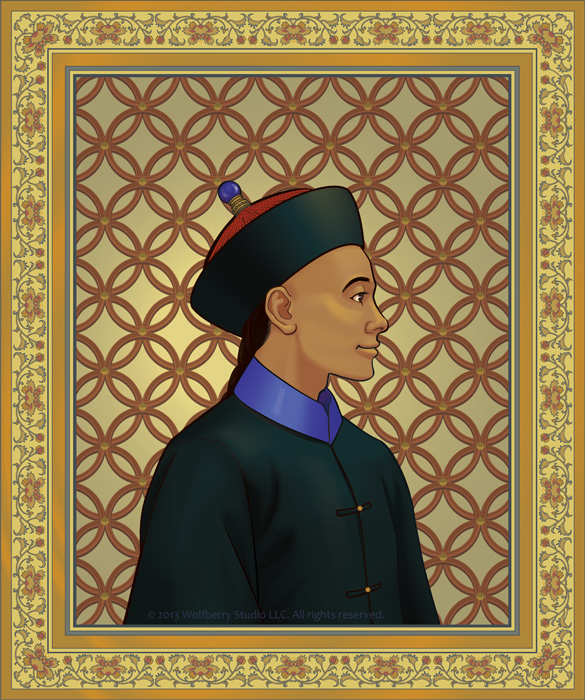
Portrait of an Official
You can see why I decided to portray an official in informal uniform instead of ceremonial or formal dress. ;-) It's much less work, lol. Hats for formal occasions have a hat spike instead of a hat knob,2 and hat quills differentiated status according to color - blue quills for 6th rank and below, peacock quills for 5th rank and above,3 - and the number of 'eyes' in the peacock feathers.4 Formal uniform also required rank badges.5 The ceremonial6 necklace of 108 beads was worn by civil officials of 5th rank and higher, and military officers of 4th rank and above.7
Thursday, November 28, 2013
Portrait of a Courtier
Costume references used are 18th century Mughal era paintings. I originally wanted to have the character facing right, but realized that the left side of the garment had more detail than the right, so I decided to save myself some trouble.
;-)
Wednesday, November 9, 2011
The Fox Phonologist
Print available.
The excerpt above probably refers to Chen's term as the vice-chair of the Department of Augury, the post he held prior to his death.3 The editor of Rulin Gongyi was Tian Kuang (1005-1063).4
Apparently, "nine tail fox", as used during the Song period, was not intended to be a flattering metaphor. But things had not always been so.
The 3rd century BCE text Annals of Lu mentions how Da Yu, founder of the ancient Xia Dynasty, encountered a nine-tail fox at Tu Mountain (in present day Henan, China); he regarded it as a good omen, and so married a woman of the Tu Mountain tribe.1 During the Han Dynasty, the 9-tail fox was still seen as an auspicious creature, portrayed together with other mythical beasts in the entourage of the goddess Xi Wangmu.1
Saturday, November 6, 2010
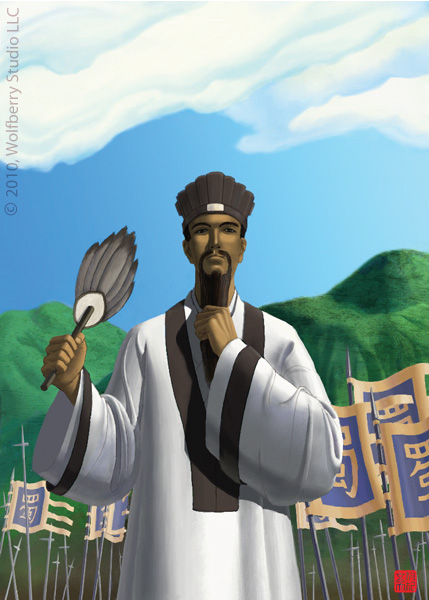
Zhuge Liang, husband of the inventor Huang Yueying
Zhuge Liang (181-234 CE), courtesy name Kongming, was a Shu Kingdom politician and military strategist during China's Three Kingdoms era. He is the putative inventor of the sky lantern, aka the Kongming lantern. (Sky lanterns were appropriated by Disney in the 2010 animated film Tangled.)
His wife Huang Yueying, an inventor of automata, was behind of one of Kongming's best known technological innovations, "wooden ox and flowing horse", a military transport used to supply the Shu Army. According to "The Corpus of Zhuge, Marquis of Zhongwu", compiled by by Zhang Shu of the Qing Dynasty:
"When Lord Zhuge dwelled in Longzhong, some visitors arrived. He asked his wife Lady Huang to make noodles. The noodles were ready within a very short time. The Marquis marvelled at his wife's speed, and later observed her work in secret. He saw multiple wooden people cutting noodles and milling flour at the speed of flight. He then supplicated his wife to teach her craft to him. Later he adapted her techniques to create the wooden ox and flowing horse."1Similar accounts exist in the the Ming Dynasty work "Anthology of Zhuge of Zhongwu", and the 1709 "Compendium of Zhuge, Marquis of Wu."1