

Showing posts with label Southeast Asia. Show all posts
Showing posts with label Southeast Asia. Show all posts
Friday, August 8, 2025

Saturday, February 8, 2025

Monday, July 8, 2024
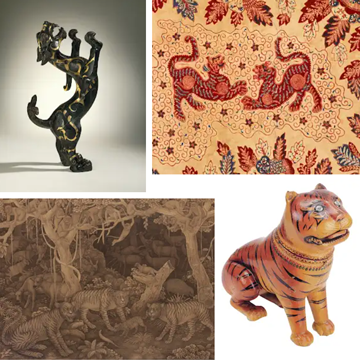
Tiger Art: a curated collection
More than 50 pieces from museums around the world, via Google Arts and Culture. Centering artists from Southeast Asia, South Asia and East Asia. Btw, July 29 is International Tiger Day
Saturday, May 1, 2021
Saturday, December 28, 2019

Sunday, June 16, 2019

Sunday, February 10, 2019

Friday, July 27, 2018

Wednesday, June 27, 2018
Tales of married women murdered by their stepmothers even after they moved away from their abusive step-family
These 3 folktales from Armenia, India and Vietnam share strikingly similar motifs - and not just because a fish has a role to play in all three tales.The differences are just as interesting:
The Golden Maiden (Armenia):
There was a young woman who whose father married a widow who mistreated her and her younger brother. The stepmother pressured her husband into abandoning his two children in the mountains. The siblings managed to find their way home, but not before the brother had been magically transformed into a lamb. The stepmother wanted to eat the lamb, so the maiden took her brother and fled once more into the mountains. There, she met a fairy crone who took pity on her and changed her into a golden-haired fairy maiden with golden garments.
The golden maiden returned home with her brother and hid her golden garments. But she could not hide her golden hair. Her stepmother, on hearing how her stepdaughter came by her golden hair, sent her own daughter from a previous marriage to the mountains. But the fairy crone disliked the stepsister and turned her into a hideous being. Because of that, the stepmother hated her stepchildren even more.
Friday, December 25, 2015
Fantasy, Mythology and Folklore art inspired by Southeast Asia
Click below to view Illustrations, fine art, and graphic novels created by artists from Thailand, Indonesia, the Philippines and the United States:

Wednesday, October 28, 2015
Banana tree spirits in Chinese and Southeast Asian oral tradition

Interesting similarities and differences between concepts of banana tree ghosts in various countries:
Pontianak/ Kuntilanak
Region: Malaysia/ Singapore/ IndonesiaNang Tani
Origin:
Ghosts of women who died during pregnancy, pontianaks are believed to reside in banana trees1
Appearance and behavior:
A pontianak manifests as a white-skinned, long-haired woman. Dressed in white, she flies about in the night.2 She can also take the appearance of a normal, attractive woman to entice men.3
The pontianak devours the organs of their victims.1 Pontianaks also haunt pregnant women and cause miscarriages.4
Region: ThailandBa Jiao Jing /Ba Jiao Gui (banana demon/ ghost)
Origin:
A nature spirit that lives in Kluai Tani, a species of wild banana, she is also known as Phi (Ghost) Tani or Phrai (Nymph) Tani.5
Appearance and behavior:
Nang Tani manifests as a green-skinned young woman in green Thai traditional dress. She appears on full moon nights. Nang Tani is thought to be a gentle spirit that a man can summon through ritual to become his wife. But conjugal relations with her will drain a man's vitality.6
Region:ChinaBa Jiao Jing can be summoned by tying a red string to the banana tree. According to rural oral lore, placing the other end of the string under the bedchamber window of one's enemy would lead the banana spirit to him. After nights of carnal relations with the blood-sucking demon, the man would wither and die.7
Origin:
One regional tale attributed this demon's origin to the grisly murder of a woman by bandits. Her parents buried her dismembered body under a banana tree.
Appearance and behavior:
The woman's vengeful spirit would leave the tree at night to suck the blood of her killers.7
Modern accounts from Chinese communities in Southeast Asia tell of men blackmailing/ torturing banana tree spirits into divulging winning lottery numbers.8 Such acts by humans don't always go unpunished. Not all accounts of human-banana spirit relations are negative. Here are a couple of stories that provide a different take on banana spirits:
Wednesday, February 25, 2015
Part 1 of How NOT to Get a Wife: Stealing Wings
A recurring theme in myths and folktales from very different cultures is the earthly or mortal man acquiring a wife of non-human origin by stealing her property, deceptively withholding information from her or otherwise limiting her options. Four stories from Vanuatu, Philippines, China and Pakistan all share these elements:
- An earthbound or mortal man.
- Celestial women or fairies who come to earth to bathe.
- The man steals the wings/clothing of one of the women, preventing her from returning to the heavens.
- Lacking other options, she stays and becomes his wife.
- The wife eventually returns to her home.
- He finds a way to follow her. (Outcomes vary)
Friday, August 29, 2014
Crossing the water on the backs of beasts
Filipino, Malaysian and Japanese tales about a small clever animal who tricks dangerous creatures into serving as its "bridge" :
Notes:
| Region | Small Trickster vs Big Predators | Tale |
|---|---|---|
| Malaysia | Mouse-deer tricks Crocodiles | Sang Kancil, startled by a crocodile on a river bank, talks his way out of danger by claiming to be taking a crocodile census on the order of the king. When the crocodiles line up on the surface of the water, Sang Kancil crosses to the other bank by hopping from one crocodile's back to another's.1,2
The animal kancil, pronounced 'kanchil', is also known as the lesser mouse-deer or lesser Malay chevrotain.3 |
| Philippines | Mouse-deer tricks Crocodiles | Pilandok wanted to cross a deep river, so he calls out to the crocodiles, pretending that he needed to count them. After stepping across their backs to the other side, Pilandok mocks them and flees.4,5
The animal called pilandok is also known as the Philippine mouse-deer or the Balabac chevrotain.6 |
| Japan | Hare tricks Wanizame | A hare wanted to cross from an island of Oki to Cape Keta, so it lied to a clan of wanizame about counting them to see whose clan was bigger.7 (Wanizame are variously interpreted as sharks, soft-shell turtles, or crocodiles.8) Although the hare managed to cross the sea by stepping on the backs of these creatures, the trickster of this tale fared much worse than its counterparts in Southeast Asia.9 |
Notes:
Sunday, July 27, 2014
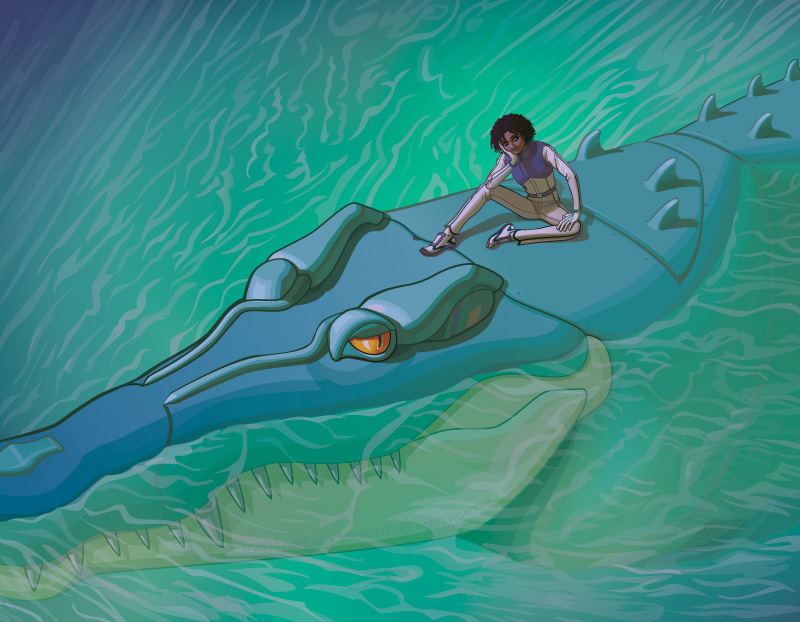
Voyage
Inspired by the East Timorese myth of "The Boy and the Crocodile".
Here are 3 different versions of the story:
Here are 3 different versions of the story:
- Legend of East Timor: The Crocodile Story (East Timor and Indonesia Action Network)
- The crocodile that became Timor (from Fernando Sylvan's "Cantolenda Maubere")
- Some cultural notes, humors and myths from Timor-Leste (Diak Ka Lae? A Dummy's Guide to Timor-Leste)
Print available!
This is the third and final piece in the giant robots series. Many thanks to the kind friends who assisted with critique.
This is the third and final piece in the giant robots series. Many thanks to the kind friends who assisted with critique.
Tuesday, March 25, 2014
Wires

Check out the beauty and complexity of the marik empang, a beaded shoulder covering worn by Iban women in traditional garb.
There are approximately 1 million Iban people living in Malaysia, Indonesia and Brunei. Notable Iban people include Rentap, a war leader who fought against British colonial rulers, and Golda Mowe, a novelist who writes fiction based on Iban history and mythology. Golda Mowe was critical of Hollywood's treatment of Iban culture:
"it was turned into some form of white man’s fantasy of having a child-like beautiful Eurasian woman come willingly into his bed. The Sleeping Dictionary continues to nettle me, even today..."
Wednesday, October 30, 2013
Skull modification around the world
| Arawe skull lengthening in Papua New Guinea | Mangbetu skull elongation in DRC |
 |
 |
The scifi illustration Through the Gate was inspired by elegant Mangbetu head shapes and hair-styles.
A (non-exhaustive) list of cultures that practiced head shaping for aesthetic or social reasons:
A (non-exhaustive) list of cultures that practiced head shaping for aesthetic or social reasons:
Friday, August 30, 2013
Sun Eaters, Moon Eaters
From Asia and the Americas, myths about animals/demons that devour the sun or the moon:
Wednesday, December 26, 2012
Three Tales of Children Born from Plants
| Folktale | Country | Mode of Child's Delivery | |
|---|---|---|---|
| Timun Mas | Indonesia | Cucumber | |
| Meng Jiang Nu | China | Gourd | |
| Kaguya Hime | Japan | Bamboo Stalk |
In one version of Timun Mas (Golden Cucumber), a giant gives a childless farming couple some magic cucumber seeds. In another version, it was a childless widow who accepted the giant's offer of help. The farmer(s) carefully cultivate the plants, which yielded a large cucumber. On cutting the vegetable open, the prospective parent(s) was/were delighted to find a baby girl inside. But the giant's help came with strings attached...
Tuesday, November 27, 2012
Genie of the Moon

...in some ancient layer of Malay beliefs before the introduction of Saivism, the white spirit of the sun, the black spirit of the moon, and the yellow spirit of sunset may have been important, seeing that they have Indonesian names (mambang), have been incorporated into the Malay's Hindu pantheon, and have survived under Islam as humble genies...
Sunday, September 4, 2011
Guardian of the Gate

Background graphics combine influences from Shirow Masamune's Ghost in the Shell and decorative art from the Malay world.
Patterns on the outfit also inspired by (but not claiming to be an authentic representation of) fabric designs from Indonesia and Malaysia.
Print available on storenvy.com.
Phone cases, stickers, and more products available on redbubble.com.
Subscribe to:
Posts (Atom)