
Yakshas are nature spirits in Hindu, Jain and Buddhist texts. Suri’s yakshas
have their roots in the guardian deities of Indian tradition but develop their own unique characteristics in Suri’s universe.

Meet some South Asian scholars and content creators who present LGBT stories from contemporary life, history and tradition.
Children’s books by LGBTQ+ South Asian authors: picture books and novels by writers from South Asia and the South Asian diaspora in Africa, Europe and North America.


The intense spiritual bonds between Sufi masters in South Asia and their same-sex disciples have been expressed in homoromantic and homoerotic poetry.

While it may not be appropriate to label these relationships using modern Western concepts of sexual orientation and romantic orientation, they can provide perspectives on the intersection between divine love and same-sex human love. The experience of holiness is not tied to heteronormativity.
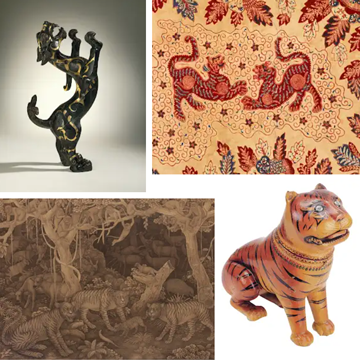
More than 50 pieces from museums around the world, via Google Arts and Culture. Centering artists from Southeast Asia, South Asia and East Asia. Btw, July 29 is International Tiger Day

The ducks in the picture are Lesser Whistling Ducks, a species present in the India subcontinent, southern China and Southeast Asia. Female and male ducks are similar in plumage.
Read more LGBTQ history on our Substack
Happy Mother's Day to the trans moms!


Kadal Kanni is available on various RedBubble products such as laptop skins and face masks.
Dear cat art aficionados, wishing you a Happy International Cat Day on 8/8!
Tired of paging through the some arts app's mostly Eurocentric highlights looking for work created by artists from the global majority?
Good news. I've put together the following collection in Google Arts and Culture for your enjoyment :-)

Cat art from non-European cultures - 52 images of cats created by non-European artists in ancient and modern cultures
While hunting deep in the forest, a hunter came across a chameleon who could sing and play the harp beautifully. The chameleon made the hunter promise not to tell anyone about him. But the hunter was so excited at meeting a talking chameleon that he couldn't help sharing his story with other humans, including the king.The Fiddler Tortoise (from the Ga ethnic group of Ghana):
The king sent guardsmen with the hunter to confirm his story. "If there is such a chameleon, I will make you rich. But if there is not such a chameleon, you will pay with your life." When the hunter brought the guards to the chameleon in the deep forest, the chameleon kept silent. So the guards assumed that the hunter had been lying and killed him. After that, the chameleon spoke, "He brought about his own death. I told him not to tell anyone about me, but he had to tell the world because of his greed."1
A monkey who lived near the ocean decided to befriend a shark. From his tree, he threw fruits to the shark, who gratefully ate them. After many days, the shark invited the monkey to a feast at his home to meet his parents."Monkey and the Crocodile" from the Panchatantra Tales of India:
The monkey was persuaded, and the shark carried it off on its back. On the way, the shark revealed that his father was ill, and a monkey's heart was needed to cure him. The monkey then lied, saying that he left his heart at home. With that, the shark turned back and swam back to shore to pick up the monkey's heart. As soon as the monkey reached land, he escaped up a tree and threw a big branch at the shark, rebuking his false friend.1
One day, a monkey living in a jamun tree by the river befriended a crocodile resting under the tree. He threw jamum to the crocodile. This went on for many days. Then the crocodile asked the monkey for some fruit to take home to his wife. The monkey obliged.Although the two folktales are structurally similar, there are some differences in interpretations. In the Indian version, the crocodile is described as actually enjoying the fruits. In the Kenyan version retold by Dr Vincent Muli Wa Kituku, the shark's acceptance of food outside of its natural diet is interpreted as a pretense to win the monkey's friendship.1 Dr Kituku equated the shark to people who present a fake lifestyle in order to win a relationship, only to show their true colors later. (I think we've all met that sort of person at some point)
After eating the fruit, the crocodile's wife said that the monkey must be even tastier than the fruit. She demanded that her husband bring her the monkey's heart to eat. The crocodile was initially appalled, and refused to do this. But his wife refused to eat anything until she could eat the monkey's heart.2
So the crocodile invited the monkey to dinner at his home to meet his wife. After some persuasion, the monkey go onto the crocodile's back. Once in deep water, the crocodile revealed that his wife wanted to eat the monkey's heart. The monkey then lied, saying that he left his heart in the tree. With that, the crocodile swam back to the monkey's tree. After the monkey escaped into the tree, he scolded the shark for his deceit and faithlessness.
There was a young woman who whose father married a widow who mistreated her and her younger brother. The stepmother pressured her husband into abandoning his two children in the mountains. The siblings managed to find their way home, but not before the brother had been magically transformed into a lamb. The stepmother wanted to eat the lamb, so the maiden took her brother and fled once more into the mountains. There, she met a fairy crone who took pity on her and changed her into a golden-haired fairy maiden with golden garments.
The golden maiden returned home with her brother and hid her golden garments. But she could not hide her golden hair. Her stepmother, on hearing how her stepdaughter came by her golden hair, sent her own daughter from a previous marriage to the mountains. But the fairy crone disliked the stepsister and turned her into a hideous being. Because of that, the stepmother hated her stepchildren even more.
A dog got into its master's house when its master went out and left the door open. It took meat from the table. Then it saw its own reflection in the large mirror in the room. Seeing another dog with meat in the mirror, the dog attacked it to get the other dog's meat. The mirror fell on the dog and killed it.1From India:
In the Foolish Lion and the Clever Rabbit from the Panchantara tales, an old rabbit saved itself from becoming the lion's meal by setting the lion against its own reflection in a well.From Greece:
The Dog and Its Reflection" is one of Aesop's fables.Notes
There was a young woman Magotu who said that she would only marry the most handsome man in the world. Her parents were worried that she was refusing all her suitors.From the Fon ethnic group of Benin:
A devil, having heard of the matter, disguised himself by borrowing the best features from the handsomest young men. Magotu accepted his proposal and left the village with him. Before long, the devil gave up his borrowed features and showed his true form. A small dog that had followed them along the way encouraged the woman to run away before the devil ate her. The devil pursued them, but the dog and the maiden met a human ally who told them how to shake off their pursuer. They returned to Magotu's village where the elders concluded that "It was not good for a woman to be so particular in the choice of a mate". 1

 |
| Abu Simbel Temple (photo by Than217) |
 |
| Bet Medhane Alem church (photo by Julien_Demade) |
 |
| Mada'in Saleh" (photo by SammySix) |
 |
| Cave 21 at Ellora (photo by Nandanupadhyay) |
 |
| Detail of Naqsh-e Rustam (photo by Pastaitaken) |


