Wednesday, May 28, 2014

Cheetah Weeping

Cheetah
Inspired by the Zulu folktale concerning the origin of the black lines running down a cheetah's face from its eyes. These lines were the tear tracks of a mother cheetah weeping for her lost cubs. The young cheetahs had been stolen by a hunter who wanted to train them to hunt for him.

When the mother's grief came to the attention of an old man from the hunter's village, he informed the village elders of the hunter’s conduct. The villagers expelled the hunter. The old man returned the cheetah cubs to their mother, reuniting the family. But the tear tracks remained on the cheetah’s face as a reminder to hunters not to do wrong again.

The moral condemnation for keeping hunting cheetahs is certainly not universal. Listed here are a few (not all) of the peoples that had tamed cheetahs for hunting:

Sunday, April 27, 2014

Sand painting in Asia and North America

Click thumbnails to view larger images on source pages.
Sand painting in Millicent Rogers Museum
Navajo sand painting
Rangoli in Chennai
Indian kolam

Some cultures that practice impermanent sand painting:

Tuesday, March 25, 2014

Wires

Cyborg
Inspired by (but NOT claiming to be an accurate representation of) the accessories of the Iban people of Borneo.

Check out the beauty and complexity of the marik empang, a beaded shoulder covering worn by Iban women in traditional garb.


There are approximately 1 million Iban people living in Malaysia, Indonesia and Brunei. Notable Iban people include Rentap, a war leader who fought against British colonial rulers, and Golda Mowe, a novelist who writes fiction based on Iban history and mythology. Golda Mowe was critical of Hollywood's treatment of Iban culture:
"it was turned into some form of white man’s fantasy of having a child-like beautiful Eurasian woman come willingly into his bed. The Sleeping Dictionary continues to nettle me, even today..."

Thursday, February 27, 2014

Use names and true names in our world and Earthsea

Fans of Ursula Le Guin's Earthsea fantasy series are familiar with the concept of true names and use names: All things have a 'true name'. People are generally given a use name at birth, the name they use in public life. When a person comes of age, his/her true name is revealed to him/her by a magic practitioner,1 but this true name is generally kept secret and only shared with trusted individuals.

Anyway I find it interesting that the concept of private 'true names' in Earthsea has its parallels on our mundane world of Earth. Anthrolopologist Theodora Kroeber, mother of Ursula Le Guin,2 wrote: "A California Indian almost never speaks his own name, using it but rarely with those who already know it, and he would never tell it in reply to a direct question."3

The Tohono O'odham people who inhabit Arizona and northern Mexico also have an Earthsea-like naming tradition. Karen Liptak wrote in "Indians of the Southwest": "In times past, a Tohono O'odham mother and her new baby would stay in a special house for a month after the birth. Then a sunrise ceremony was held, at which the medicine man gave the baby a name that had come to him in a dream. This name was never spoken. Instead, nicknames were used."4

Notes:
  1. "The Rule of Names" on wikipedia
  2. Theodora Kroeber on wikipedia
  3. Ishi apparently wasn't the last Yahi, according to new evidence from UC Berkeley research archaeologist
  4. Karen Liptak, Indians of the Southwest, p52

Friday, January 24, 2014

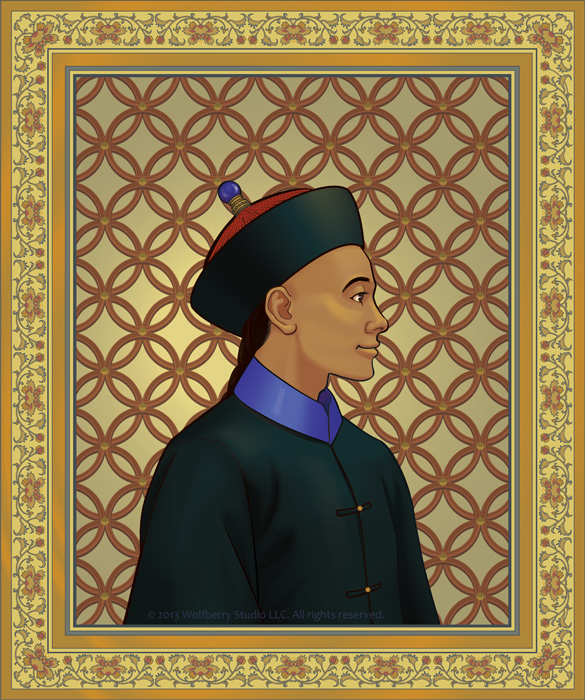
Lattices (and other parallels between Qing-era China and Mughal-era India)

Inspired by latticework designs from China and Mughal India:
Profile of young Qing Dynasty official

For beardless versions of these gentlemen, see Portrait of an Official and Portrait of a courtier. :-)

Some random (or not so random) parallels between the Qing period (1644-1912) in China and the Mughal period in India (1526-1857):
  • Both dynasties were established by non-indigenous rulers:
    • The Mughal Dynasty was established on the Indian subcontinent by Turko-Mongols from Uzbekistan.1
    • The Qing Dynasty was established in China by Jurchens from Manchuria (present-day Northeastern China).2
  • The capitals of both the Qing and the Mughals experienced repeated slaughter of their populations, looting of cultural treasures and destruction of exquisite architecture:

Friday, December 27, 2013

Portrait of an Official

Profile of young Qing Dynasty official
The color and material of the sphere in the hat finial indicates an official's rank.1 An opaque blue hat knob indicates an official of the 4th rank.

You can see why I decided to portray an official in informal uniform instead of ceremonial or formal dress. ;-) It's much less work, lol. Hats for formal occasions have a hat spike instead of a hat knob,2 and hat quills differentiated status according to color - blue quills for 6th rank and below, peacock quills for 5th rank and above,3 - and the number of 'eyes' in the peacock feathers.4 Formal uniform also required rank badges.5 The ceremonial6 necklace of 108 beads was worn by civil officials of 5th rank and higher, and military officers of 4th rank and above.7

Thursday, November 28, 2013

Portrait of a Courtier

Profile of young Mughal courtier
Influenced by the art and design of Mughal India. Lattice background is inspired by the stone latticework designs of India.

Costume references used are 18th century Mughal era paintings. I originally wanted to have the character facing right, but realized that the left side of the garment had more detail than the right, so I decided to save myself some trouble.
;-)